

How much does it cost to heat a home in 2026? Let’s do the math!
Published on 19 October 2026Updated on 19 October 2026by Catarina Costa
- Storage
- Self-consumption
- HVAC
- Energy Efficiency
In this post
With natural gas and electricity becoming more expensive, and fuel prices continuing to fluctuate, heating the home remains a concern for many Portuguese families. But what if you could become less dependent on these costs and use energy from the sun to heat your home?
When we think about household expenses, mortgage payments, food and monthly electricity and water bills come to mind immediately.
Heating is different: for much of the year it may be a minor expense, but as temperatures fall, energy consumption can increase considerably.
Families with natural gas central heating keep an eye on tariffs. Those using heating oil boilers worry about the next delivery. And anyone relying on electricity to heat their home also feels the effect of changes in energy prices.
Although these households use different energy sources, they face the same question: how much does it really cost to keep a home comfortable?
Fortunately, alternatives are available that can change the way we produce and use energy for heating.
Some can even use electricity produced on the roof of the house itself.
But is replacing your current heating system worthwhile? Let's do the maths!
Gas and electricity prices rose in October 2026. What does that mean for families?
October brought new energy price changes in Portugal.
According to the Portuguese Energy Services Regulatory Authority (ERSE), effective 1 October 2026:
- Natural gas rose by 6.4% in the regulated market.
- Electricity increased the average monthly bill by approximately 2.7% for most domestic customers in the regulated market.
These figures apply to the regulated market. In the liberalised market, prices depend on each supplier's offer and the customer's contract.
How much do these increases add to bills?
ERSE provided examples for different household consumption profiles.
| Energy | Consumption profile | Average monthly bill after update | Monthly increase |
|---|---|---|---|
| Natural gas | Couple without children, 1,610 kWh/year | €17.38 | +€0.91 |
| Natural gas | Couple with two children, 3,407 kWh/year | €32.53 | +€1.62 |
| Electricity | Couple without children, 1,900 kWh/year and 3.45 kVA | €37.77 | +€0.95 |
| Electricity | Couple with two children, 5,000 kWh/year and 6.9 kVA | €97.73 | +€2.70 |
Source: ERSE, June and September 2026 announcements. Figures for mainland Portugal, including taxes and charges under the respective announcements.
At first glance, these increases seem small. For the profiles used, they are.
But there is a crucial distinction: these examples do not necessarily reflect a house that uses gas or electricity for space heating throughout the winter.
A home with substantial heating needs can consume considerably more energy than these reference profiles.
For electricity, ERSE increased the energy component by €0.005/kWh.
For example, a household using 5,000 kWh of electricity annually solely for heating would face an additional direct cost of around €25 a year before taxes because of this change.
The individual increase is not necessarily large. It raises a broader question: the more energy a home needs for heating, the greater the potential effect on the household budget.
Heating oil users face another challenge. Unlike natural gas supplied through a network, heating oil generally requires a storage tank and periodic deliveries. Prices depend on suppliers, commercial terms and developments in oil markets.
The next delivery may therefore cost more or less than the last.
Rather than looking only at tariff changes, it is worth asking:
Can we maintain the same comfort while consuming less energy and reducing running costs?
How much does it cost to heat a house with gas, heating oil or electricity? Let's do the maths.
Imagine a house that needs 10,000 kWh of useful heat per year to keep its rooms warm.
Useful heat is the thermal energy actually delivered to the home after equipment conversion losses.
We will keep this heating requirement constant and apply defined energy prices to compare several technologies.
Scenario one: natural gas boiler
A boiler with a seasonal efficiency of 90% needs approximately 11,111 kWh of natural gas to deliver 10,000 kWh of useful heat.
At €0.10/kWh:
11,111 kWh × €0.10 = approximately €1,111 per year.
Scenario two: heating oil boiler
A heating oil boiler with seasonal efficiency of 85% needs approximately 1,176 litres to deliver the same heat, assuming an energy content of 10 kWh per litre.
At €1.30/litre:
1,176 litres × €1.30 = approximately €1,529 per year.
What if the fuel price changes?
| Assumed heating oil price | Annual heating cost |
|---|---|
| €1.10/litre | €1,294 |
| €1.30/litre | €1,529 |
| €1.50/litre | €1,765 |
In this example, a difference of just €0.20 per litre means around €235 more per year.
Scenario three: conventional electric heating
Electric resistance heating turns virtually all the electricity it consumes into heat.
Delivering 10,000 kWh of useful heat therefore requires approximately 10,000 kWh of electricity.
At €0.18/kWh:
10,000 kWh × €0.18 = approximately €1,800 per year.
This illustrates an important distinction: not all electricity-powered heating systems use energy equally efficiently.
Other technologies can deliver the same useful heat with much less electricity. This is where heat pumps come in.
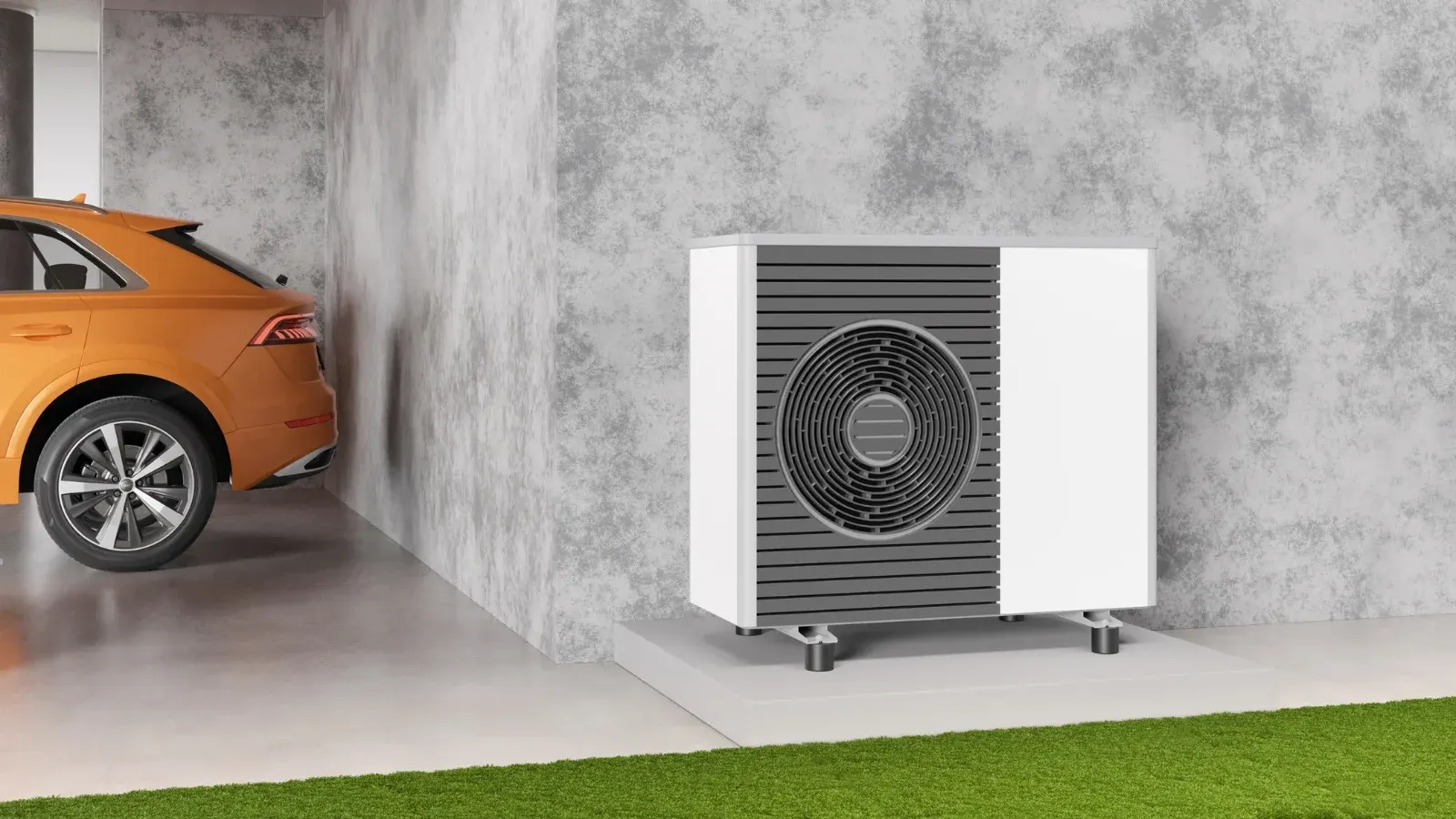
Heat pumps: how can you deliver more heat with less energy?
A heat pump works differently from a conventional boiler or electric resistance heater.
Rather than burning fuel or producing heat directly from electricity, it uses electricity to transfer thermal energy from the outdoor environment into the home.
This is what enables its high efficiency.
According to the European Commission, modern heat pumps can be three to five times as efficient as conventional gas boilers, depending on operating conditions.
A heat pump with a seasonal coefficient of performance (SCOP) of 3, for example, delivers an average of three kWh of heat for every kWh of electricity used over the reference period.
What would it cost to heat the same house with a heat pump?
Let us return to the annual requirement of 10,000 kWh of useful heat.
A heat pump with SCOP 3 would use approximately 3,333 kWh of electricity.
At €0.18/kWh:
3,333 kWh × €0.18 = approximately €600 per year.
Here are the four scenarios:
| Heating system | Annual variable energy cost |
|---|---|
| Electric resistance heating | €1,800 |
| Heating oil boiler | €1,529 |
| Natural gas boiler | €1,111 |
| Heat pump | €600 |
For the same heat requirement, the difference is substantial.
In this example, the heat pump's annual variable energy cost is approximately:
- €511 lower than the natural gas boiler.
- €929 lower than the heating oil boiler.
- €1,200 lower than electric resistance heating.
This helps explain why, even as electricity prices rise, an efficient heat pump can still have lower running costs than other solutions.
What matters is not only the price per kWh of energy, but how much useful heat the system delivers from that energy.
And there is another opportunity: combining a heat pump with solar photovoltaic generation.
Heat pump + solar panels: when your home produces some of the energy it uses
A heat pump uses electricity efficiently. A solar photovoltaic (PV) system produces electricity at home.
Working together, these technologies can use solar electricity to cover part of the home's heating demand.
During daylight hours, the panels can power household appliances, including the heat pump.
Whenever solar production and consumption coincide, less electricity needs to be purchased from the grid.
But what might this mean in practice?
Let's return to the numbers.
Our heat pump needs approximately 3,333 kWh of electricity a year for heating.
Imagine a suitably sized PV system and a favourable usage pattern supplying 30% of that electricity through solar self-consumption.
Grid electricity purchased for heating would then fall to approximately 2,333 kWh a year.
At €0.18/kWh:
2,333 kWh × €0.18 = approximately €420 per year.
How do five heating solutions compare for the same house?
| Heating solution | Estimated annual variable cost |
|---|---|
| Electric resistance heating | €1,800 |
| Heating oil boiler | €1,529 |
| Natural gas boiler | €1,111 |
| Heat pump | €600 |
| Heat pump + solar PV | €420 |
In this example, the combination of a heat pump and solar PV would reduce the annual variable cost of purchased energy by approximately:
- €1,380 compared with electric resistance heating.
- €1,109 compared with a heating oil boiler.
- €691 compared with a natural gas boiler.
The main benefit is not simply producing electricity. It is using that electricity efficiently and reducing dependence on energy purchased from the grid.
This is why designing solar PV and heating as an integrated system can be particularly worthwhile.
What about winter, when there is less sun? Batteries can help.
Solar panels still produce electricity during winter, although output is generally lower than in summer.
There is another challenge: many families need heating in the late afternoon and evening, when solar production has stopped.
This is where battery storage may add value.
A battery can store some of the surplus solar electricity produced during the day for later use, including to run a heat pump.
The three technologies can work together:
| Solution | What it does for your home |
|---|---|
| Solar PV panels | Produce renewable electricity. |
| Heat pump | Uses electricity to deliver highly efficient heating. |
| Battery | Stores surplus solar electricity for later use. |
A battery does not increase solar production or remove the need for the electricity grid when solar generation is insufficient.
However, when daytime surplus and evening consumption are both significant, a battery can help make better use of the electricity produced.
The goal is not to install every technology available. It is to choose what genuinely makes sense for your home.
No central heating? Air conditioning can also provide heating.
Not every home has radiators, underfloor heating or the hydraulic infrastructure required for an air-to-water heat pump.
In such cases, reversible air conditioning can be an attractive alternative.
Although often associated with cooling, modern air conditioning systems also use heat pump technology.
That means one system can heat in winter and cool in summer.
As well as controlling the temperature in individual rooms, air conditioning can use electricity generated by solar PV panels or supplied by a battery.
Air-to-water heat pump or air-to-air conditioning: which suits your home?
| Air-to-water heat pump | Air-to-air conditioning |
|---|---|
| Can supply underfloor heating, fan coils and compatible radiators. | Heats and cools the air directly in rooms. |
| Can also provide domestic hot water. | Provides heating in winter and cooling in summer. |
| Can make use of an existing hydraulic system, if compatible. | Can suit homes without central heating. |
| Can use electricity generated by solar panels. | Can also use solar PV electricity. |
There is no universally best solution.
An air-to-water heat pump may be appropriate for homes with compatible hydraulic central heating. Air conditioning may be advantageous where that infrastructure does not exist or individual rooms need conditioning.
The choice depends on the home's requirements, existing equipment, installation conditions and budget.
When does replacing a heating system make sense?
These examples show what different technologies can offer, but every home needs its own assessment.
A house with an old boiler, high consumption and frequent maintenance requirements is very different from a recently built, well-insulated home with low heating demand.
Before investing, it is important to understand annual energy use, the current system's efficiency and actual heating needs.
Existing heat emitters, the electrical installation, the solar potential and the possible value of battery storage should also be considered.
Finally, investment costs should be compared with running and maintenance costs over time.
The goal should not be to install more equipment. It should be to find the right balance between comfort, energy efficiency and investment.
This is where an experienced partner can make a difference.
At Enbiente, you can find all these solutions with one partner.
Making a home more energy-efficient should not mean having to find a different company for every part of the project.
One company for a heat pump. Another for solar panels. Another for batteries. And yet another to make everything work together.
At Enbiente, we believe in a different approach.
We are A One Stop Shop for Sustainability.
With one partner, you can access heating, air conditioning, solar PV and energy storage solutions, supported by a team that takes an integrated view of your home's needs.
From the initial assessment through system design and installation, we help identify the most appropriate technologies for each project.
Rather than recommending equipment in isolation, we consider how each system can work with the others efficiently, reliably and at an appropriate level of investment.
Whether you want to replace a natural gas or heating oil boiler, install a heat pump, condition your home with air conditioning or harness solar energy, Enbiente offers the solutions and technical support you need.
Note on the calculations
The examples in this article are for illustrative purposes only.
The assumed prices are simulation inputs.
The calculated costs represent only the variable energy component, on a simplified basis, excluding taxes, fixed charges, upfront investment, maintenance and the potential alternative value of surplus solar electricity.