
Energy Management: ISO 50001 as a driver for sustainability
Published on 10 September 2026Updated on 10 September 2026by Catarina Costa
- Incentives & Policy
- Energy Efficiency
- Business & ESG
In this post
Knowing how much a company pays for energy is important.
But it is not the same as knowing how that energy is actually being used.
Which equipment accounts for most of the consumption? Is energy being used outside operating hours? Is the company consuming more because it is producing more, or because it has become less efficient? Are the measures already implemented actually delivering the expected results?
Answering these questions is the starting point of effective energy management.
At a time when energy costs, efficiency, decarbonisation and regulatory requirements are becoming increasingly important, energy can no longer be viewed simply as a monthly expense.
It becomes a management variable.
This is where ISO 50001 comes in.
ISO 50001: much more than a certification
ISO 50001:2018 is the international reference standard for Energy Management Systems.
Its purpose is to help organisations of different sizes and sectors continuously improve their energy performance through a structured methodology.
The logic is relatively simple.
First, the organisation needs to understand its current situation: how energy is used, where the main consumption occurs and which factors influence it.
Then, objectives and improvement actions are defined.
The results are measured and compared with what was expected.
And that information is used to identify further opportunities.
It is a continuous process of planning, implementing, checking and improving.
The 2018 edition remains current and was complemented in 2024 by an amendment introducing the need to consider climate change within the context of management systems.
More than obtaining a certificate, the objective is to make energy part of the organisation's regular management processes.
Consuming more does not necessarily mean being less efficient
This is one of the simplest examples of why energy data needs to be interpreted properly.
Imagine a factory that consumed 10% more energy than in the previous year.
At first sight, we might conclude that its performance has deteriorated.
Now imagine that, over the same period, production increased by 25%.
In that case, despite consuming more energy overall, the factory may actually be using less energy per unit produced.
This is why robust energy management does not look only at kWh.
It also uses Energy Performance Indicators, adapted to the reality of each activity.
Examples may include:
- kWh per tonne produced
- kWh per unit manufactured
- kWh per square metre
- energy consumption per operating hour
The question is no longer simply:
“How much do we consume?”
It becomes:
“How much energy do we need to achieve a given result?”
The difference may appear small, but it completely changes the quality of the analysis and the decisions that follow.
To manage energy, you need to measure it
An energy bill provides an overall view of a site's consumption.
Effective energy management often requires going further.
An industrial facility may include motors, compressors, refrigeration, HVAC, thermal processes, lighting and several production lines operating at the same time.
If consumption increases, knowing only the total figure does not make it easy to identify the cause.
This is where energy monitoring becomes essential.
Meters, power analysers, sensors and data acquisition systems make it possible to monitor equipment and processes, identify patterns and detect situations that might otherwise go unnoticed.
This does not mean monitoring every piece of equipment from day one.
An efficient approach usually starts with significant energy uses: the equipment, processes or systems that represent a substantial share of consumption or offer the greatest potential for improvement.
This is precisely where EnbiTrack plays an important role.
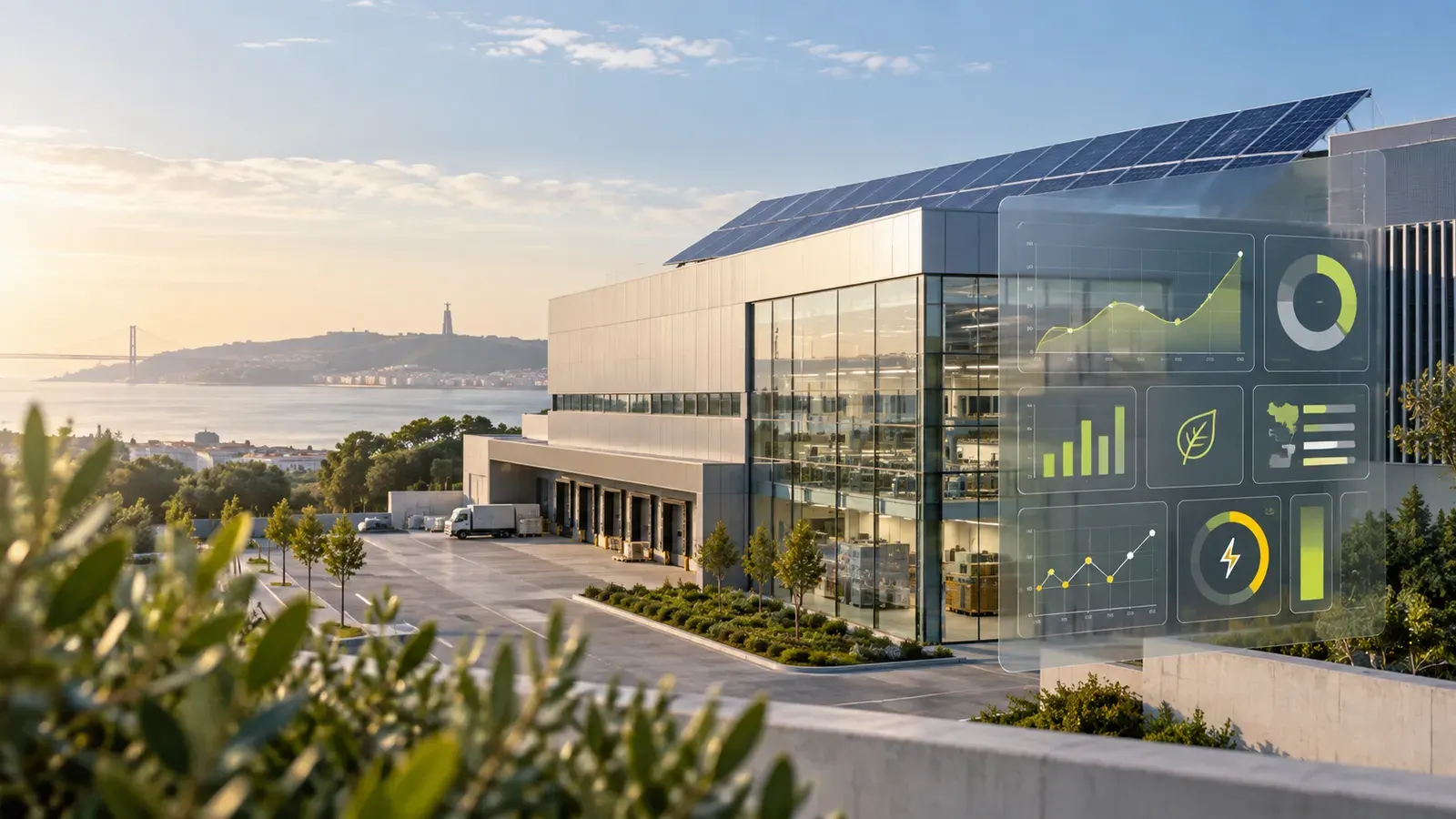
The platform centralises data from different equipment and systems, allowing organisations to monitor consumption and generation, review historical data, identify anomalies, configure alarms and maintain a continuous view of the site's energy behaviour.
Equipment running outside its expected schedule, an unexpected demand peak or a gradual change in the consumption profile no longer depends exclusively on an occasional review to be detected.
It becomes visible in the data.
And this is particularly important within an Energy Management System:
there can be no continuous improvement without the ability to measure continuously.
From data to decisions
But collecting data is not enough.
A company may have thousands of measurements available and still not know where to act.
The real value emerges when data is transformed into useful information for decision-making.
The organisation needs to identify its main consumers, establish baselines, understand which variables affect energy use and assess improvement opportunities.
This is where the technical role of EnbiCertif complements monitoring.
By assessing energy performance and analysing facilities from a technical perspective, it becomes possible to identify inefficiencies, understand existing energy behaviour and define improvement measures on a stronger technical basis.
EnbiTrack can then be used to follow the evolution of those measures and verify whether the actual results match what was expected.
This creates a logical cycle:
assess → measure → implement → verify → improve.
It is precisely this logic that turns an isolated intervention into an energy management strategy.
Not every improvement requires major investment
Another common mistake is to associate energy efficiency exclusively with equipment replacement.
Some measures naturally require investment. But many opportunities come simply from improving the way existing systems are operated.
Equipment running unnecessarily, inappropriate setpoints, excessive compressed-air pressure, leaks, poorly defined schedules or uncoordinated processes can all create avoidable energy consumption.
When sufficiently detailed information is available, these situations become much easier to identify.
In other cases, the analysis may justify more structural investments, such as:
- replacing equipment with more efficient solutions
- heat recovery
- improving HVAC or refrigeration systems
- on-site photovoltaic generation
- energy storage
- load management and load shifting
The principle should always be the same:
understand the problem first; choose the technology afterwards.
An efficient solution installed in the wrong place or operated incorrectly can still be a poor investment.
Photovoltaics and batteries are also part of energy management
This approach becomes even more important as energy systems become increasingly complex.
A company may consume electricity from the grid, generate power through photovoltaics, store energy in a battery and simultaneously supply HVAC systems, industrial processes or electric vehicle chargers.
In this scenario, reducing consumption remains important, but it is no longer enough.
The organisation needs to understand when to consume, when to generate, when to store and when to use the energy available.
A battery, for example, may be used to increase self-consumption, reduce demand peaks, shift loads or improve continuity of service.
But the right strategy depends on the site's actual energy profile.
The same is true for photovoltaics.
The better the consumption curve is understood, the better the system can be sized and operated according to real needs.
Energy management therefore becomes the link between different technologies.
Is ISO 50001 mandatory?
This is an area where generalisations should be avoided.
Not every company with significant energy consumption is automatically required to obtain ISO 50001 certification, and several regulatory frameworks need to be distinguished.
Energy-intensive consumers - Portuguese SGCIE
In Portugal, the Energy-Intensive Consumption Management System (SGCIE) currently applies to facilities with annual energy consumption equal to or greater than 500 toe - tonnes of oil equivalent.
These facilities are subject to specific obligations, including periodic energy audits and the preparation and implementation of Energy Consumption Rationalisation Plans (PREn).
Facilities consuming between 500 and 1,000 toe are currently subject to minimum targets of a 4% reduction in energy intensity and specific energy consumption. For facilities consuming 1,000 toe or more, that target rises to 6%.
View the SGCIE framework on the Portuguese Directorate-General for Energy and Geology website
There is, however, an important distinction:
being covered by the SGCIE does not, by itself, automatically require a facility to obtain ISO 50001 certification.
Electro-intensive customers
The situation is different for facilities that obtain Portugal's Electro-Intensive Customer Status.
In this case, Portuguese legislation expressly requires the implementation, within a maximum of three years after joining the scheme, of an auditable Energy Management System certified according to EN ISO 50001:2018, or its successor, by a certification body accredited for that purpose by IPAC, the Portuguese accreditation institute.
View the legal framework for Electro-Intensive Customers
In this framework, there is therefore an explicit legal requirement linked to ISO 50001.
What is changing at European level?
Directive (EU) 2023/1791 on energy efficiency introduces a new approach based on the company's average annual energy consumption over the previous three years, taking all energy carriers into account.
The Directive requires Member States to ensure that:
- companies with average annual consumption above 10 TJ that do not operate an Energy Management System are subject to energy audits
- companies with average annual consumption above 85 TJ implement an Energy Management System certified by an independent body in accordance with relevant European or international standards
For companies above the 85 TJ threshold, the system must be in place by 11 October 2027.
The European Commission identifies EN ISO 50001 as the main international reference for this type of Energy Management System.
There is another relevant technical difference.
The current SGCIE threshold is assessed at facility level, while the European Directive uses the average consumption of the enterprise, considering all energy carriers over the previous three years.
For large energy consumers, the direction is clear: the ability to measure, document and systematically improve energy performance is becoming increasingly important, not only economically but also from a regulatory perspective.
Sustainability starts with understanding energy performance
Improving energy performance is not only a way of reducing costs.
It also means using resources more efficiently.
When a company needs less energy to achieve the same result, it reduces waste, improves energy productivity and can reduce the environmental impact associated with its activity.
At the same time, more mature energy management creates a much stronger foundation for integrating renewable generation, storage, electrification and decarbonisation strategies.
ISO 50001 itself was amended in 2024 to strengthen the consideration of climate change within the context of organisations.
View ISO 50001:2018/Amd 1:2024
This means organisations must consider factors that may affect their energy performance, from heatwaves and increased cooling demand to risks related to resource availability or continuity of energy supply.
Energy management therefore becomes linked not only to efficiency, but also to resilience.
From obligation to competitive advantage
A company may first consider ISO 50001 because it needs to comply with a legal requirement, respond to a customer or prepare for an audit.
But limiting the system to compliance means using only part of its potential.
Understanding energy consumption makes it possible to identify waste, detect anomalies, justify investment and demonstrate results.
It also makes it possible to understand whether an efficiency measure has genuinely worked, whether a photovoltaic system is being used effectively or whether a battery is creating the value for which it was designed.
This is where energy management stops being merely about compliance and becomes business management.
Through EnbiCertif, Enbiente works on technical assessment and energy performance, helping organisations identify improvement opportunities and establish a stronger technical basis for decision-making.
Through EnbiTrack, that assessment gains continuity through monitoring, data analysis, historical records and site alarms.
Based on this information, concrete measures can then be defined and implemented in energy efficiency, renewable generation, storage or process optimisation.
It is also important to distinguish this technical support from formal ISO 50001 certification, which must be performed by an independent and appropriately accredited certification body.
Because a robust energy strategy does not start by choosing a technology.
It starts by understanding the facility.
Your company knows how much energy it consumes. But does it really know where, when and why?
At Enbiente, we help find those answers and turn them into concrete decisions to improve your organisation's energy performance.