
Solar panels in condominiums: moving forward became easier in 2026
Published on 26 August 2026Updated on 2 September 2026by Catarina Costa
- Solar PV
- Self-consumption
- Incentives & Policy
In this post
Installing solar panels in a condominium has become simpler.
Since 1 July 2026, the installation of renewable energy generation systems in condominiums can be approved by a simple majority of condominium owners.
But what does this mean in practice for people who live in or manage an apartment building?
For years, having a suitable roof and plenty of sunshine was not always enough for a condominium to move forward with solar energy.
Very often, the main obstacle was not the roof or the technology.
It was the condominium meeting itself and the difficulty of obtaining the approval required to install equipment in a common area of the building.
Since July 2026, that reality has changed.
Law No. 29/2026 of 23 June amended the Portuguese Civil Code and established that, in buildings with at least two autonomous units, the installation and operation of renewable energy generation systems for self-consumption depends on approval by a simple majority of condominium owners.
Read Law No. 29/2026 of 23 June
It may seem like a small change, but it could make a significant difference for thousands of Portuguese apartment buildings.
So what has actually changed?
The main change concerns the condominium's decision.
Until now, a photovoltaic installation on a common roof could fall under the general rules applicable to so-called innovations in condominiums, where the required majorities made many projects difficult to approve.
The new law created a specific rule for renewable energy generation.
In practice, it has become easier to bring a photovoltaic project to a condominium meeting and obtain approval to move forward.
This does not mean that any installation can be carried out automatically or that technical and administrative requirements no longer apply.
It simply means that one of the main barriers within the condominium itself has been removed.
Do all residents have to take part?
Not necessarily.
It is important to separate two different decisions:
one thing is for the condominium to authorise the installation of the system; another is to define who participates in the use of the energy produced and how.
When several consumers use locally generated energy, this is known as Collective Self-Consumption.
The name may sound complex, but the idea is simple.
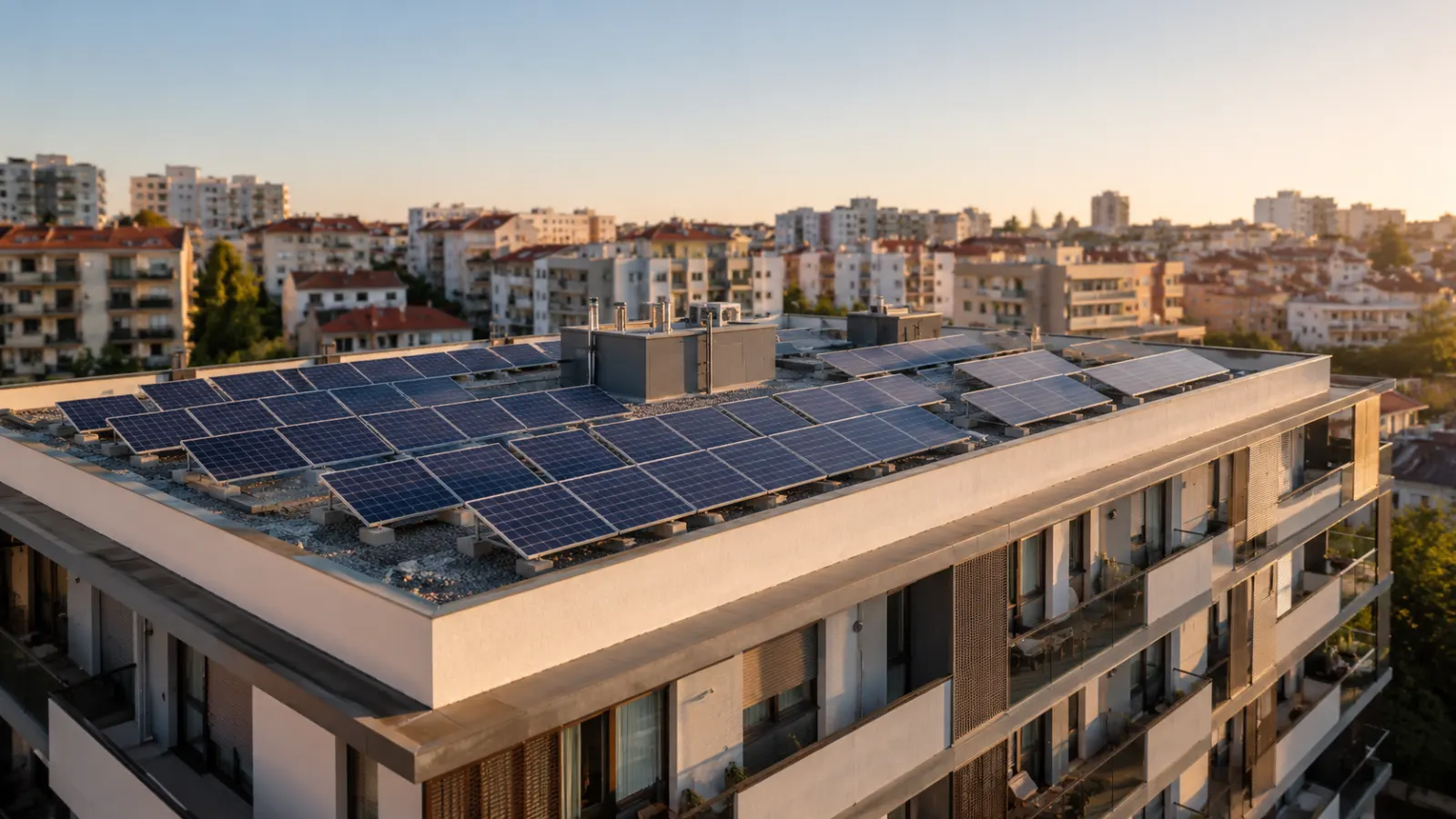
Imagine an apartment building with solar panels on the roof.
Instead of all the energy serving just one consumer, the electricity generated can be allocated among different participants in the building according to the rules defined for the project.
Portugal's Directorate-General for Energy and Geology, DGEG, describes Collective Self-Consumption as a model in which several consumers can benefit from energy generated by one or more production units.
Learn more about Collective Self-Consumption at DGEG
How is the energy divided?
This is one of the most important decisions in the project.
The energy produced can be allocated among participants according to previously defined criteria.
And there is no single solution that works in the same way for every building.
Imagine, for example, two families.
One home is empty for most of the day and concentrates most of its electricity consumption in the late afternoon and evening.
The other has people working from home, appliances running during the day and significantly higher consumption precisely when the solar panels are producing electricity.
Although both families live in the same building, their consumption profiles are completely different.
That is why a good collective self-consumption project should look at consumption first and only then decide how many panels should be installed.
Does every condominium benefit from solar panels?
No.
And this is probably the most important analysis to carry out before taking the subject to a vote.
Having available roof space does not automatically mean that a photovoltaic system is a good investment.
Several factors need to be assessed, including:
- available roof area
- orientation and inclination
- shading
- the condition and characteristics of the roof
- electricity consumption in common areas
- consumption of participating units
- the times of day when that consumption occurs
- how much of the generated energy can be used directly
- the required investment
- the possibility of using or selling surplus energy
- and, in some cases, whether energy storage makes sense
A building with lifts, garages, pumps, HVAC systems or other equipment operating during the day may have a particularly interesting consumption profile.
But every case should be assessed individually.
The objective should not be to “fill the roof with panels”.
It should be to install the amount of photovoltaic capacity that makes sense for the building's consumption and the condominium's objectives.
Collective self-consumption is already growing in Portugal
Although many people are still unfamiliar with the concept, collective self-consumption is growing quickly.
In August 2026, DGEG announced that Portugal already had more than 2,000 Collective Self-Consumption projects in operation.
Between June and July alone, 837 new projects entered operation.
See the data published by DGEG
These projects may involve citizens, businesses, public bodies and communities, not only condominiums, but the figures clearly show that local energy generation and sharing is gaining momentum in Portugal.
The new simple-majority rule may now help make this solution more accessible to residential apartment buildings as well.
Is licensing required?
It depends on the characteristics of the installation.
Not every photovoltaic system follows exactly the same procedure.
Installed capacity, the way the system is connected and other project characteristics determine which requirements apply.
There is also another important development in 2026.
From 28 August 2026, Decree-Law No. 130/2026 comes into force, further amending several rules in the electricity sector, including provisions related to self-consumption.
The new regime applies to the relevant procedures initiated after it comes into force.
Read Decree-Law No. 130/2026 of 29 June
This means there is no single licensing deadline that can be applied indiscriminately to every photovoltaic system in a condominium.
The applicable procedure must be assessed for each project.
For someone living in a condominium, the most important thing is not to know every article of the legislation, but to ensure that whoever develops the project correctly manages the applicable technical and administrative process.
What happens after the system starts producing energy?
A collective self-consumption project does not end when the solar panels are installed.
The relationship between the different participants also needs to be defined.
The new regime provides, for example, for an internal regulation for Collective Self-Consumption, setting out matters such as the entry and exit of participants, how energy is shared, what happens to surplus electricity and other operating rules.
It may sound bureaucratic, but it serves an important purpose: preventing future disputes.
When the project is properly structured from the beginning, everyone knows how it works, who participates and what the rules are.
What if the condominium does not want to make the investment?
Law No. 29/2026 also introduced another new mechanism: the Renewable Energy Use Agreement, known in Portuguese as CAER.
In simple terms, this mechanism allows a third party to be granted the right to make energy use of certain spaces, including roofs and rooftop areas, in order to install and operate renewable energy generation equipment.
This may enable models in which the owner or condominium does not have to directly bear the entire initial investment.
However, this is a new mechanism and its contractual framework should be carefully assessed before any decision is made.
It should not simply be seen as “free solar panels”.
It is essential to understand who invests, who benefits from the energy, who is responsible for maintenance, what responsibilities exist regarding the roof and what happens to the equipment at the end of the contract.
What should an interested condominium do?
The first step should not be to immediately request a quotation for a specific number of panels.
It should be to understand whether there is a good project for that particular building.
An initial assessment can answer much more important questions:
How much electricity does the building consume?
When is that energy consumed?
How much roof area is available?
How much electricity can be generated?
Who wants to participate?
How could the energy be allocated?
What investment will be required?
How much could the condominium or participants save?
Only after answering these questions does it make sense to define the technical solution.
This means that when the project reaches the condominium meeting, the discussion stops being:
“Do you think we should install solar panels?”
and becomes:
“This is the project, this is the investment and these are the expected benefits.”
The difference is significant.
In summary
What changed?
Since 1 July 2026, the installation and operation of renewable energy generation for self-consumption in buildings with at least two autonomous units has required approval by a simple majority of condominium owners.
Do all residents have to participate?
Approval of the installation and participation in self-consumption are separate matters. The participation and energy-sharing model must be defined as part of the project.
Can any building install solar panels?
Technically, many can. But that does not mean every building has the same economic viability. Each building needs to be assessed.
Can the energy be shared?
Yes. That is precisely the principle behind Collective Self-Consumption.
Are administrative procedures still required?
Yes. Requirements depend on the characteristics of the installation, and the legal framework is being updated again from 28 August 2026.
An opportunity many condominiums can now reconsider
Photovoltaic panels are no longer a novelty on Portuguese rooftops.
In condominiums, however, the challenge has never been purely technological.
Different owners, consumption profiles, interests, investment decisions and rules for using a shared area all have to be aligned.
The 2026 legislative change does not eliminate those challenges.
But it removes an important barrier to decision-making.
For many buildings, this may be the right moment to reconsider a project that previously seemed too difficult to approve.
At Enbiente, we assess each project based on real consumption, the characteristics of the building and the objectives of the participants, supporting the entire process from study and system design through to installation, monitoring and technical support.
If you manage or live in a condominium and want to understand whether the building has the potential to generate its own energy, talk to us.
We assess the project and help turn the idea into a concrete proposal, with clear figures to take to the next condominium meeting.