
Green Map: what changes for renewable energy projects in Portugal?
Published on 24 August 2026by Catarina Costa
- Solar PV
- Incentives & Policy
- Energy Transition
In this post
Portugal wants to produce more renewable energy.
But installing more solar and wind capacity does not depend on technology or investment alone. It also depends on land use, grid capacity and, above all, licensing procedures that can take years to complete.
This is precisely where the new Green Map comes in.
On 20 August 2026, the Portuguese Government approved the Sectoral Programme for Renewable Energy Acceleration Areas (PSZAER), identifying more than 800 areas across over 147 municipalities in mainland Portugal considered suitable for solar photovoltaic and onshore wind projects.
The objective is simple: identify in advance where new renewable capacity can be developed more effectively and make project development faster and more predictable.
But there is an important distinction: being located within the Green Map does not mean that a project is automatically approved.
What exactly is the Green Map?
Until now, much of the assessment of whether a specific location was suitable for a renewable energy project was carried out as part of each individual project.
Environmental constraints, heritage, agriculture, landscape, land-use planning, renewable resource availability and proximity to the electricity grid were among the factors that had to be considered throughout the process.
The Green Map changes this approach.
Instead of starting from scratch every time, the State identifies in advance the areas where there is greater compatibility with renewable energy development.
These are known as Renewable Energy Acceleration Areas, or ZAER under the Portuguese designation.
In practical terms, Portugal is now identifying in advance:
“These are the areas where the conditions are more favourable for accelerating new renewable energy projects.”
How were these areas selected?
Having strong solar irradiation or wind resources is not enough.
The definition of the ZAER took several factors into account, including:
- renewable energy production potential
- environmental sensitivity
- heritage and landscape values
- land use and spatial planning
- agricultural activity
- proximity to and integration with electricity networks
The process also included a Strategic Environmental Assessment and public consultation, with the aim of reconciling renewable energy expansion with the different uses and values present across the territory.
Because producing energy is only part of the equation.
It must also be possible to integrate that energy into the grid.
Where are the Green Map areas located?
This is naturally one of the first questions raised by the new measure.
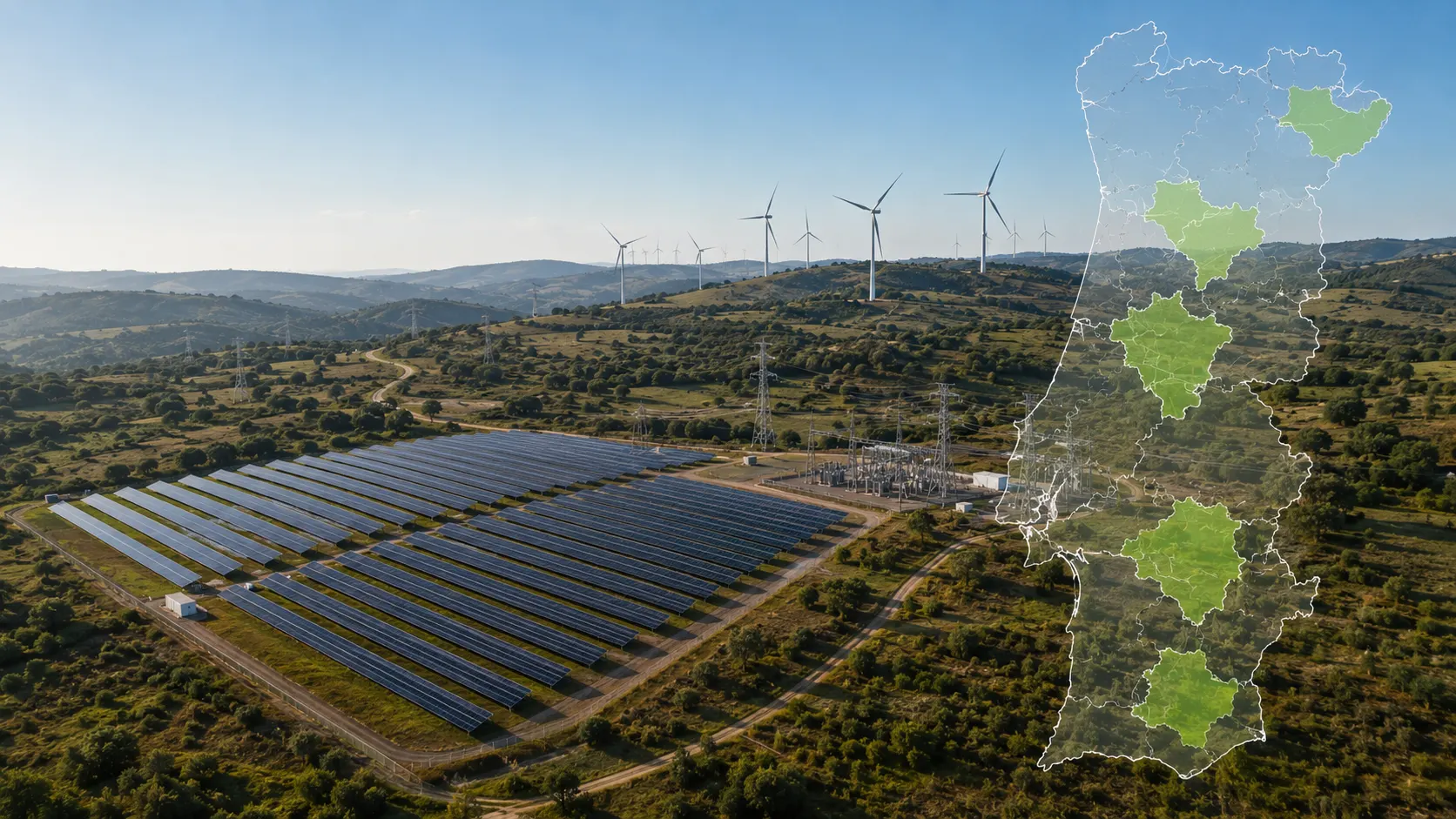
The more than 800 identified areas are distributed across over 147 municipalities in mainland Portugal, with separate areas for solar photovoltaic energy and onshore wind energy.
The geographical distribution differs significantly between the two technologies.
ZAER for solar photovoltaic energy
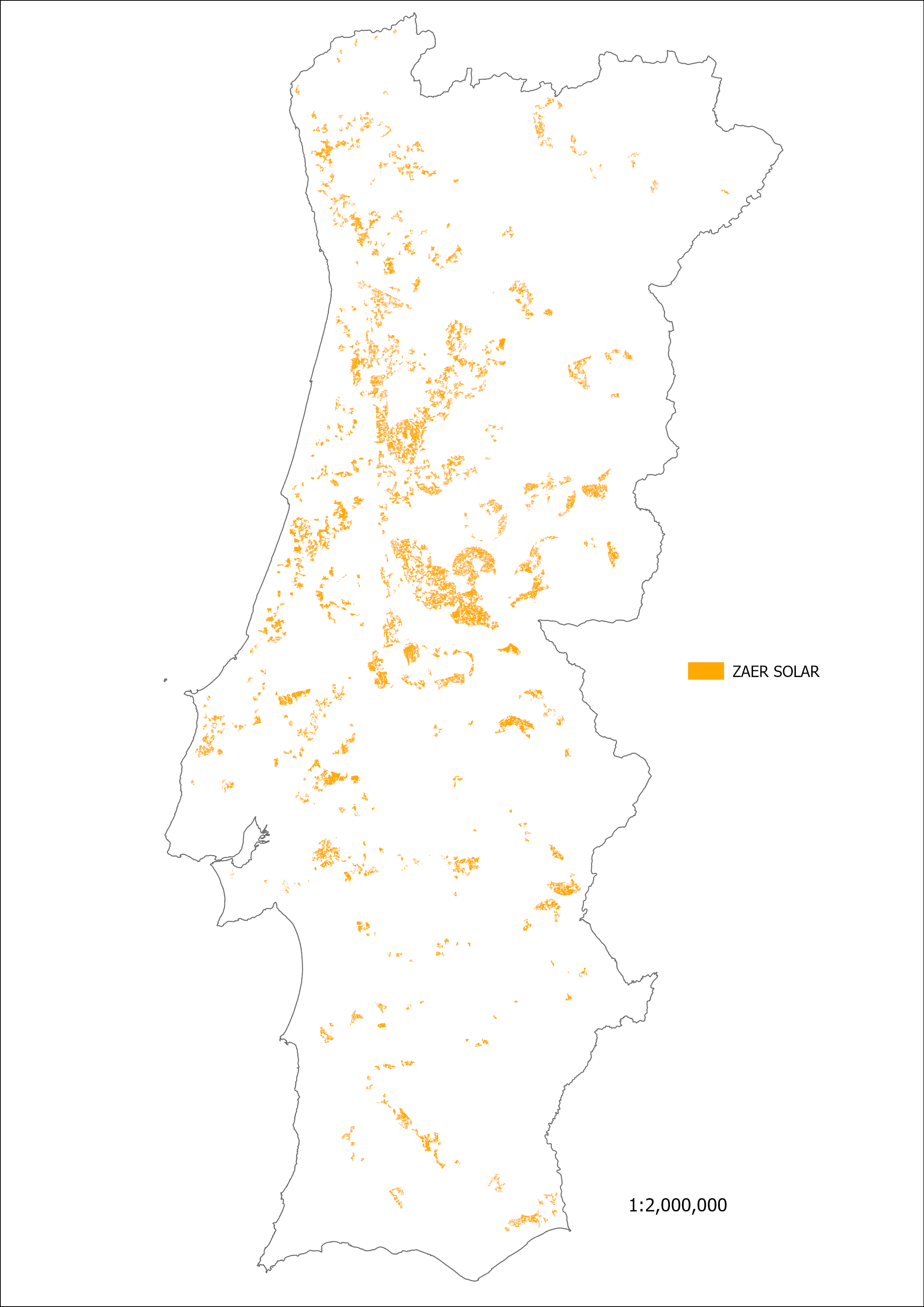
Map of the ZAER for solar photovoltaic energy. Source: Renováveis Participa / PSZAER.
For solar energy, the identified areas are spread across a significant part of mainland Portugal, although their concentration varies considerably between regions.
This does not mean that every marked area offers the same conditions for a project.
A specific project still depends on the characteristics of the site, available grid connection capacity, existing constraints and the investment itself.
ZAER for onshore wind energy
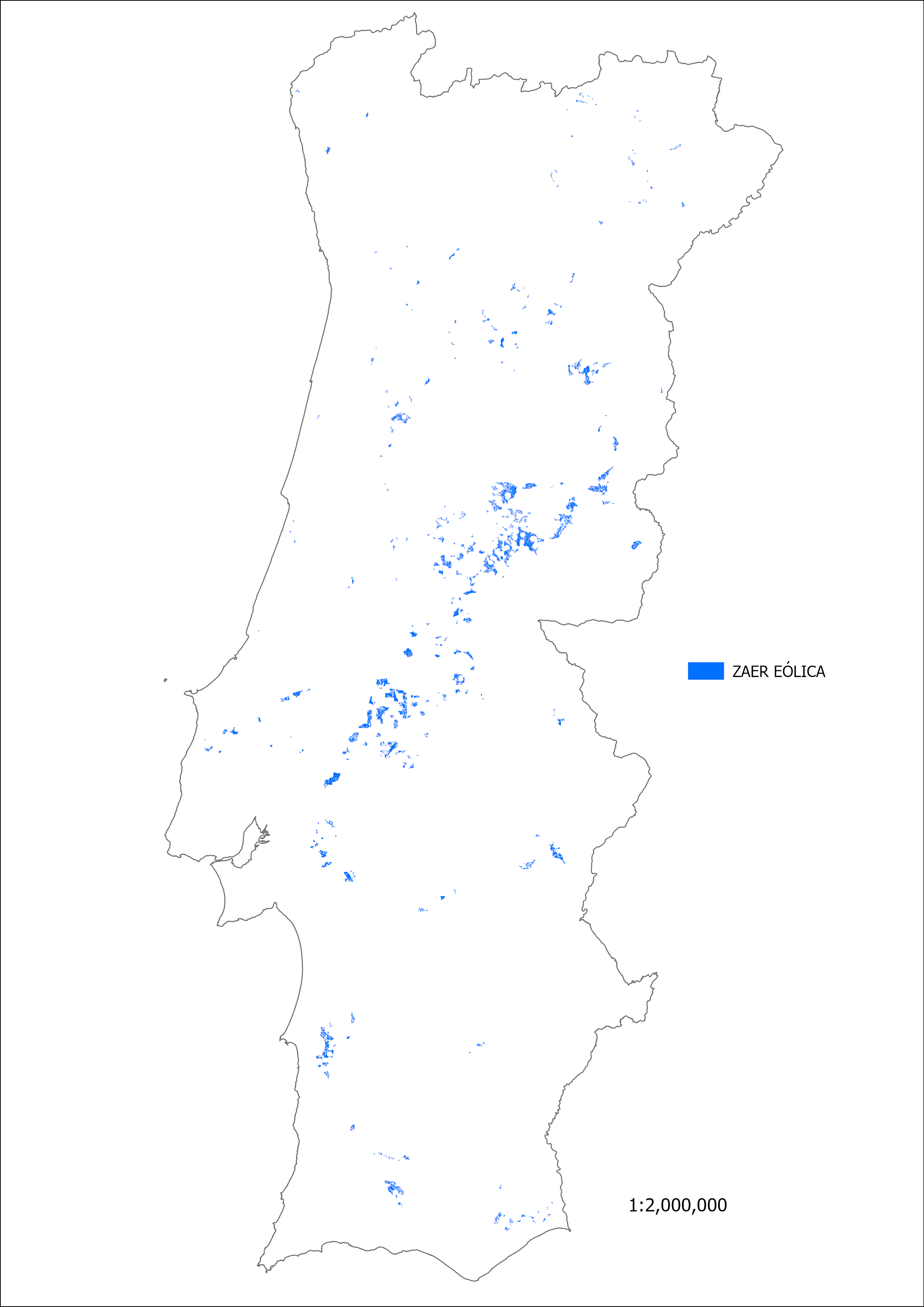
Map of the ZAER for onshore wind energy. Source: Renováveis Participa / PSZAER.
For wind energy, the distribution is more concentrated and follows the areas where technical and territorial conditions are more suitable for this type of generation.
With hundreds of areas involved, listing every municipality would not be particularly useful.
The official Renováveis Participa platform provides access to the maps, technical documentation and information made available under the PSZAER.
View the Renewable Energy Acceleration Areas
What changes in the licensing process?
This is where the Green Map becomes particularly important.
The new legal framework introduces shorter maximum time limits for projects located within ZAER.
From 28 August 2026, the maximum period for issuing a production licence for a renewable energy project is one year, but this is reduced to six months when the project is located within a ZAER.
There is another important difference.
The overall prior-control procedure for a renewable energy project may not exceed:
- 2 years outside ZAER
- 1 year when located within a ZAER
These periods may be extended in exceptional circumstances provided for in the legislation.
For developers, location can therefore become an even more important factor in investment decisions.
A shorter licensing period can mean less uncertainty, greater financial predictability and faster entry into operation.
So is it enough for the site to be on the map?
No.
This is an important distinction.
A site being located within a ZAER does not amount to authorisation to build a solar or wind power plant.
Each project must continue to comply with the applicable requirements.
To be considered located within a particular ZAER, the project must be entirely within the corresponding geographical area and comply with the eligibility criteria defined for that zone.
The Green Map therefore does not remove the need to assess an individual project.
What it does is create the conditions for part of that assessment to have already been carried out at territorial level.
What about environmental assessment?
There is also significant simplification in this area.
The legislation provides for an exemption from Environmental Impact Assessment for certain renewable energy projects, storage systems and grid infrastructure located within ZAER, provided that they comply with the rules and measures established in the environmental assessment of the relevant sectoral programme.
But this does not mean that environmental controls disappear.
There are exceptions, and every project located within a ZAER remains subject to an assessment of its environmental compliance.
If significant negative impacts are identified that were not considered when the zone itself was assessed and cannot be mitigated through the measures already established, the project may still be subject to an Environmental Impact Assessment.
In other words:
accelerating does not mean overlooking.
It means avoiding unnecessary duplication and seeking to concentrate projects in areas that have already been studied and considered more suitable.
Energy storage is also part of this change
There is another point worth highlighting.
The ZAER framework does not focus only on electricity generation.
The legal definition of these areas also includes the grid or energy storage infrastructure required to integrate renewable electricity into Portugal's National Electricity System.
This is particularly relevant.
As Portugal installs more solar and wind capacity, the challenge is gradually shifting from simply producing more electricity.
It is also about being able to:
- use energy when it is needed
- store surplus production
- manage peaks in production and consumption
- respond to grid constraints
- increase the flexibility of the electricity system
The energy transition will not be achieved through more solar panels alone.
Generation, storage, grids and energy management must work together.
Does the Green Map apply to self-consumption?
For most residential or commercial rooftop photovoltaic systems, this will not be the main change.
The Green Map is particularly relevant to the development of larger renewable energy projects, especially where land, spatial planning, environmental licensing and grid connection are involved.
A company planning to install photovoltaic panels on its roof to reduce electricity consumption operates within a very different framework from a developer planning a ground-mounted solar power plant.
It is primarily in this second scenario that being inside or outside a ZAER may make a significant difference.
A good location is still not enough
The Green Map can help identify more favourable territories.
But a viable renewable energy project still depends on much more.
Renewable resource availability, the site itself, grid capacity and connection conditions, investment requirements, expected generation, the energy sales or consumption model and the possible integration of storage all need to be assessed.
A site within a ZAER can represent an opportunity.
But that alone does not make it a good project.
Portugal is changing the way it plans renewable energy
This may be the most important change introduced by the Green Map.
Instead of assessing only on a project-by-project basis where renewables can be installed, Portugal is starting to identify in advance where it wants to create better conditions for these projects to move forward.
More than 800 areas are now part of that strategy.
The objective is to reduce uncertainty, accelerate investment and continue increasing renewable energy generation while taking the territory and its different uses into account.
At Enbiente, we closely follow this evolution.
Because developing an energy project is not simply a matter of choosing technology.
It means understanding where to generate, how to connect, when to store and how to turn that energy into a technically robust and economically sustainable investment.
If you are considering a new energy generation or storage project, talk to us.
We assess the opportunity before the investment begins.