
EU wants to curb “high-risk” inverters: energy security becomes a priority
Published on 6 May 2026 by Catarina Costa
- Solar PV
- Incentives & Policy
- Innovation & Technology
Europe’s energy transition is accelerating. But one topic is finally starting to receive the attention it deserves: the cybersecurity of energy infrastructure.
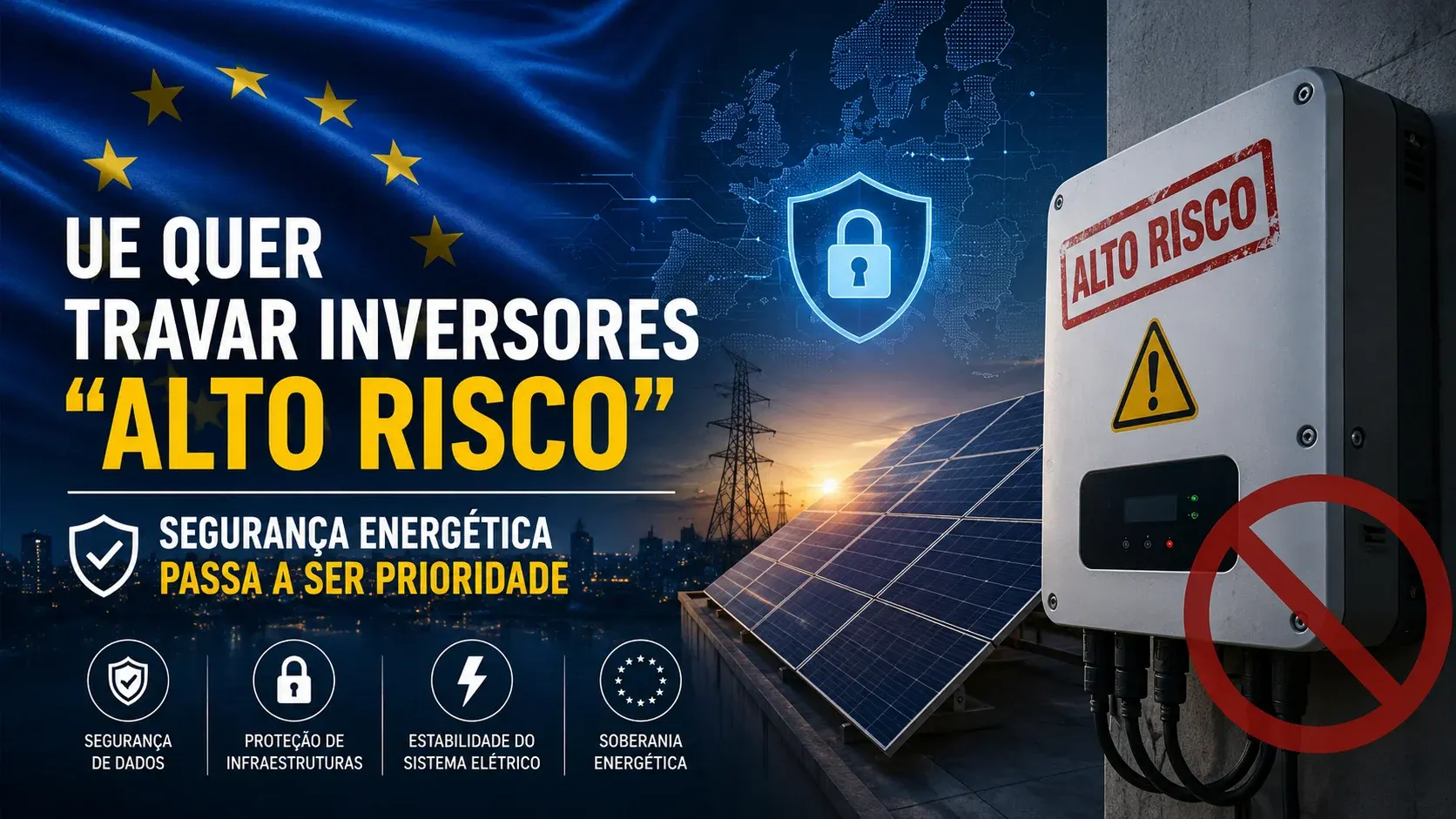
Recently, the European Commission took a firm step in that direction. The decision? To restrict the use of inverters considered “high-risk”, especially those from China, in projects financed by the European Union.
And no. This is not just a political issue. It is a matter of security.
What is really at stake?
Solar inverters are often seen simply as a technical component. In practice, however, they are the “brain” of any photovoltaic system.
They are responsible for:
- controlling energy production
- communicating with digital platforms
- managing real-time data
- and, in many cases, connecting to the internet
In other words, they are not just electrical equipment. They are intelligent devices connected to the grid.
According to the European Commission, “serious” threats to the economy and cybersecurity were identified, based on information provided by several Member States.
In the worst-case scenario? These systems could be used to interfere with the stability of the European electricity grid or even cause large-scale power failures.
A dependency that concerns Europe
Today, the global inverter market is dominated by Chinese manufacturers, with an estimated market share of around 80%.
This raises an inevitable question:
Is it sustainable to depend almost exclusively on external technology for critical infrastructure?
The European Union’s answer seems clear: no.
That is why the strategy involves:
- reducing external dependencies
- strengthening security criteria in projects
- encouraging European alternatives and suppliers from allied countries
What changes in practice?
The decision does not appear as an immediate ban, but as a progressive shift:
- EU-funded projects will face more demanding cybersecurity requirements
- Suppliers considered high-risk may be excluded from those projects
- From 2027 onwards, the rules will become even stricter
The cost impact
According to the Commission, the impact will be limited: below 2% of the total value of solar projects.
The warning Enbiente had already been giving
For those who follow Enbiente, this news is not a surprise.
Over the past few years, we have been reinforcing a simple but critical idea:
Not all technology is equal. And not all risk is visible.
We have always defended:
- the choice of European equipment or equipment with auditable origin
- the importance of secure firmware and guaranteed updates
- the need to protect our clients’ data and energy infrastructure
Because energy is not just about production.
It is also about trust, control and long-term security.
More than energy, this is about sovereignty
This decision by the European Union marks a turning point.
The energy transition is no longer just an environmental or economic issue. It is also a geopolitical and strategic issue.
Energy infrastructure is critical infrastructure.
And in an increasingly digital world, security begins with the equipment we choose to install today.
Conclusion: the future of energy will also be safer
The message is clear:
Europe is shifting its focus from efficiency to security.
And those who stay ahead of this change will be better prepared for the future.
At Enbiente, this vision has always been part of our DNA.
Because when we talk about energy, we are talking about something bigger: the future of companies, homes and society itself.
If you want to assess your system and the equipment that supports it, to ensure its security, talk to us.